Years Dedicated to the Piano
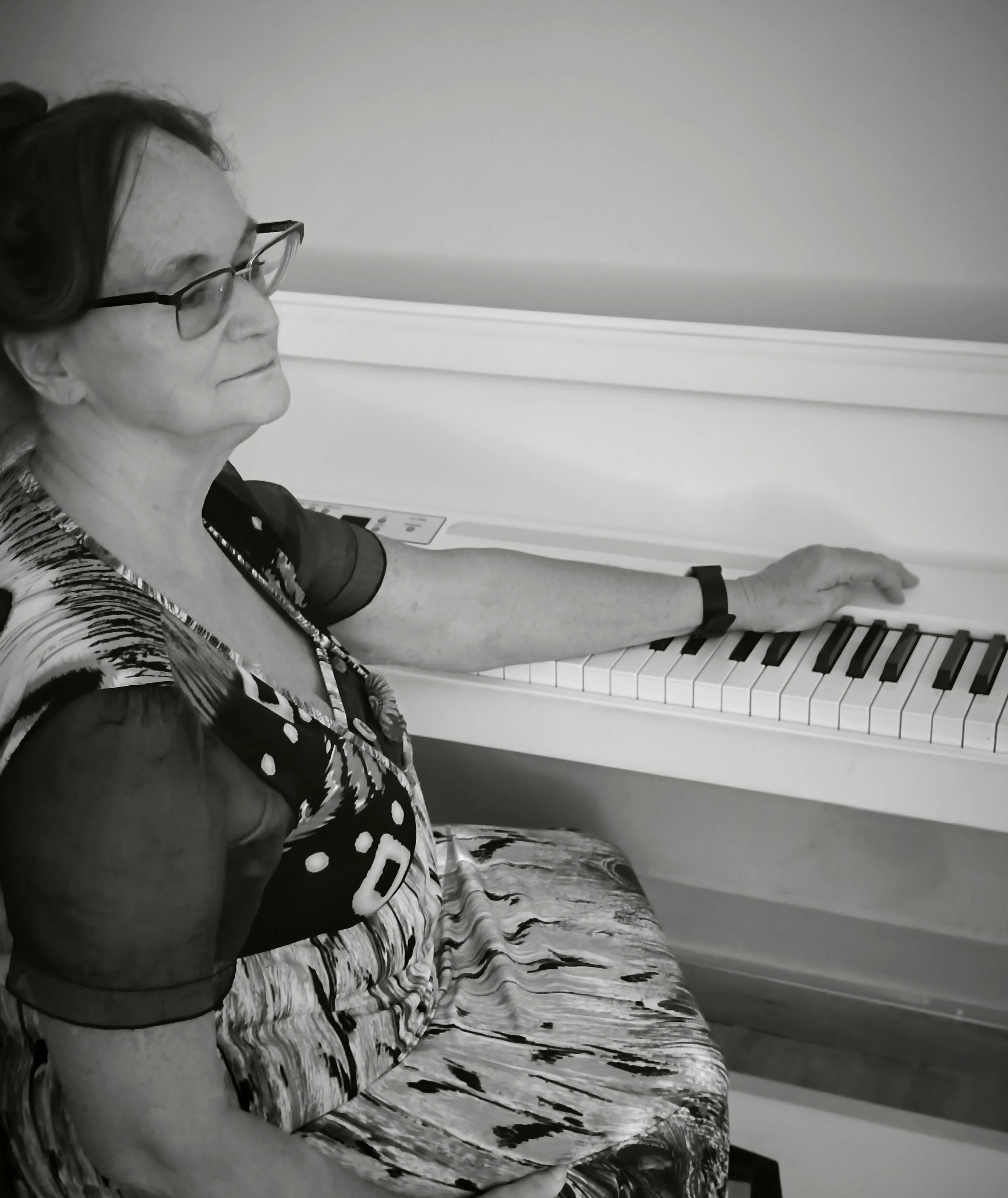
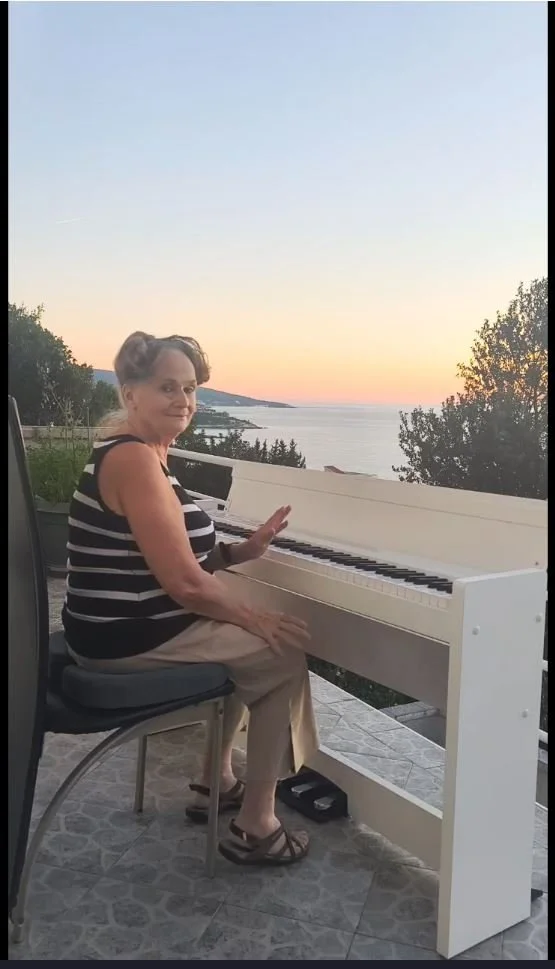
Natalia Popova’s artistic journey is rooted in the finest traditions of classical music. Graduating in 1972 from the Petrozavodsk State Conservatory with a major in Piano, she built a distinguished career spanning over five decades across Russia—from the prestigious music colleges of Vladivostok and Kaliningrad to over 12 years of master teaching at the renowned E.A. Mravinsky School of Arts in Saint Petersburg. Now, she brings this lifetime of experience, technique, and musical soul directly to you.
“Music is a magnificent world that opens up to everyone who is ready to listen.”
INTRODUCING PROFESSOR KLAVIRA
Classical piano performances, decades of mastery, and a sanctuary of healing sounds by Natalia Popova.
Bridging Eras: Wolfgang Amadeus Mozart’s "Rondo Alla Turca" (and Jazz Improvisation) on Piano
Explore the historical origin, stylistic evolution, and technical biomechanics behind one of the most celebrated and dynamically adapted masterworks in keyboard literature.
The Story and the 18th-Century "Janissary" Craze
Though widely recognized today as a standalone classical encore or even a playful mobile ringtone, the "Turkish March" (properly titled Alla Turca) was originally composed around 1783 as the third and final movement of Wolfgang Amadeus Mozart’s Piano Sonata No. 11 in A major, KV 331.
The piece was born out of a massive European craze for "Turkish music," also known as Janissary music, inspired by the traditional military bands of the Ottoman Empire. These bands captured the Viennese imagination with their exotic, powerful rhythms and distinctive instrumentation, which included bass drums, cymbals, triangles, and high-pitched piccolos. Mozart masterfully imitated this percussion-heavy sound on the keyboard. He achieved this through a driving duple meter, sharp staccato octaves, and rapid, ascending sixteenth-note passages that mimic the bright flutes and clashing cymbals of the Janissary soldiers. In Mozart's era, some pianos were even built with a specialized "Turkish stop" pedal, which added physical bell and drum-striking sound effects directly to the performance.
From Viennese Classicism to Modern Jazz Improvisation
While Mozart's original score is a beautifully structured classical Rondo (following an A-B-C-D-E-C-A-B-C-coda form), its driving pulse has made it a legendary canvas for virtuosic reinvention over the centuries.
In 1993, the renowned Turkish composer and pianist Fazıl Say took this classical foundation and created his world-famous arrangement, "Alla Turca Jazz". Say brilliantly superimposed the spirit of modern jazz and syncopated ragtime onto Mozart's themes. In his fantasy, the initial classical themes are quickly transformed with syncopated top-note accents, swinging rhythms, and chromatic "blue notes" woven into the rapid sixteenth-note runs. This tradition of crossover virtuosity has also been expanded by other master pianists like Arcadi Volodos, Stefano Bollani, and Yuja Wang, who introduced complex stride patterns, rich jazz chords, and staggering technical challenges. In her performance, Professor Natalia Popova captures this seamless dialogue between centuries, combining Viennese precision with the rich, improvisational freedom of modern jazz.
The Biomechanics of Jazz Jumps at 140 BPM
To perform "Alla Turca" with both classical clarity and the heavy, physical groove of jazz stride piano requires exceptional coordination, physical economy, and stamina.
While a standard classical tempo often sits around 116 BPM, modern and jazzy interpretations are frequently pushed to a blistering 130 to 150 BPM. To calculate the exact note density during the continuous sixteenth-note passages, we use the following mathematical formula (four sixteenth notes per beat):
NPS = (BPM × 4) / 60
If we perform the piece at a highly energetic tempo of 140 BPM, the calculation is:
NPS = (140 × 4) / 60 ≈ 9.33 not/sec
At over 9 notes per second, classical articulation is demanding enough. However, when we layer in the physical jumps of jazz "stride piano" — where the left hand must rapidly leap back and forth between deep bass octaves and mid-range chords — the mechanical demands on the body increase exponentially.
To master these rapid lateral leaps and syncopated rhythms without tension or injury, pianists must employ key biomechanical and somatic adjustments:
- Utilize Curved Lateral Arm Trajectories (No Muscular Jumping): Rather than lifting the left hand vertically and dropping it down with force, the arm must glide in a continuous, smooth, arc-like motion driven naturally by the shoulder and elbow. This minimizes resistance and utilizes gravity to hit bass notes effortlessly.
- Tactile Tracking (Feeling the Keys): Keep the fingers in light, sliding contact with the key surfaces as they sweep across the keyboard. Feeling the physical geography of the piano prevents blind jumps and reduces playing errors.
- The Wrist as a Shock Absorber: To handle the heavy, percussive chords of the jazz sections, the wrist must remain fully flexible and "breathing." A locked wrist will instantly transfer tension to the forearm, causing fatigue and slowing down execution.
- Cognitive Decoupling of Hands: Playing a strict, steady stride accompaniment in the left hand while executing highly syncopated, swung, and decorated melodies in the right hand requires complete rhythmic independence. Practice by isolating the left hand until its jump pattern becomes a relaxed, automatic reflex.
Fortepiano Acoustics & Register Color
Exploring historically informed performance and the physical limitations of period soundscapes.
- Acoustic Archaeology: Emulating the "Alla Turca" style popularized by the crashing, cymbal-ringing music of 18th-century Ottoman military bands.
- The Janissary Pedal: Period instruments by Conrad Graf or Anton Walter utilized a "Janitscharenzug" pedal to physically trigger built-in bells, cymbals, and leather drum mallets.
- Register Individuality: Unlike modern homogenized pianos, vintage fortepianos featured unique register coloring: a growling bass, a warm middle, and a silvery treble.
Microdynamics & Transient Speed
An ultimate test for your system’s transient response, slew rate, and phase coherence.
- Extreme Tempo Range: Performed from Presto to Prestissimo (160 to 208+ BPM) where the human limit meets physical acoustic speed.
- Microphone Array: Capturing micro-transients via vintage 1949 tube microphones to preserve pure, uncompressed acoustic space.
- Analog Purism: Designed around an All-Valve pure analog signal chain, bypassing digital stages to avoid digital jitter and high-frequency phase smearing.
Bridging Eras: Wolfgang Amadeus Mozart’s "Rondo Alla Turca" (and Jazz Improvisation) on Piano
Explore the historical origin, stylistic evolution, and technical biomechanics behind one of the most celebrated and dynamically adapted masterworks in keyboard literature.
The Story and the 18th-Century "Janissary" Craze
Though widely recognized today as a standalone classical encore or even a playful mobile ringtone, the "Turkish March" (properly titled Alla Turca) was originally composed around 1783 as the third and final movement of Wolfgang Amadeus Mozart’s Piano Sonata No. 11 in A major, KV 331.
The piece was born out of a massive European craze for "Turkish music," also known as Janissary music, inspired by the traditional military bands of the Ottoman Empire. These bands captured the Viennese imagination with their exotic, powerful rhythms and distinctive instrumentation, which included bass drums, cymbals, triangles, and high-pitched piccolos. Mozart masterfully imitated this percussion-heavy sound on the keyboard. He achieved this through a driving duple meter, sharp staccato octaves, and rapid, ascending sixteenth-note passages that mimic the bright flutes and clashing cymbals of the Janissary soldiers. In Mozart's era, some pianos were even built with a specialized "Turkish stop" pedal, which added physical bell and drum-striking sound effects directly to the performance.
From Viennese Classicism to Modern Jazz Improvisation
While Mozart's original score is a beautifully structured classical Rondo (following an A-B-C-D-E-C-A-B-C-coda form), its driving pulse has made it a legendary canvas for virtuosic reinvention over the centuries.
In 1993, the renowned Turkish composer and pianist Fazıl Say took this classical foundation and created his world-famous arrangement, "Alla Turca Jazz". Say brilliantly superimposed the spirit of modern jazz and syncopated ragtime onto Mozart's themes. In his fantasy, the initial classical themes are quickly transformed with syncopated top-note accents, swinging rhythms, and chromatic "blue notes" woven into the rapid sixteenth-note runs. This tradition of crossover virtuosity has also been expanded by other master pianists like Arcadi Volodos, Stefano Bollani, and Yuja Wang, who introduced complex stride patterns, rich jazz chords, and staggering technical challenges. In her performance, Professor Natalia Popova captures this seamless dialogue between centuries, combining Viennese precision with the rich, improvisational freedom of modern jazz.
The Biomechanics of Jazz Jumps at 140 BPM
To perform "Alla Turca" with both classical clarity and the heavy, physical groove of jazz stride piano requires exceptional coordination, physical economy, and stamina.
While a standard classical tempo often sits around 116 BPM, modern and jazzy interpretations are frequently pushed to a blistering 130 to 150 BPM. To calculate the exact note density during the continuous sixteenth-note passages, we use the following mathematical formula (four sixteenth notes per beat):
NPS = (BPM × 4) / 60
If we perform the piece at a highly energetic tempo of 140 BPM, the calculation is:
NPS = (140 × 4) / 60 ≈ 9.33 not/sec
At over 9 notes per second, classical articulation is demanding enough. However, when we layer in the physical jumps of jazz "stride piano" — where the left hand must rapidly leap back and forth between deep bass octaves and mid-range chords — the mechanical demands on the body increase exponentially.
To master these rapid lateral leaps and syncopated rhythms without tension or injury, pianists must employ key biomechanical and somatic adjustments:
- Utilize Curved Lateral Arm Trajectories (No Muscular Jumping): Rather than lifting the left hand vertically and dropping it down with force, the arm must glide in a continuous, smooth, arc-like motion driven naturally by the shoulder and elbow. This minimizes resistance and utilizes gravity to hit bass notes effortlessly.
- Tactile Tracking (Feeling the Keys): Keep the fingers in light, sliding contact with the key surfaces as they sweep across the keyboard. Feeling the physical geography of the piano prevents blind jumps and reduces playing errors.
- The Wrist as a Shock Absorber: To handle the heavy, percussive chords of the jazz sections, the wrist must remain fully flexible and "breathing." A locked wrist will instantly transfer tension to the forearm, causing fatigue and slowing down execution.
- Cognitive Decoupling of Hands: Playing a strict, steady stride accompaniment in the left hand while executing highly syncopated, swung, and decorated melodies in the right hand requires complete rhythmic independence. Practice by isolating the left hand until its jump pattern becomes a relaxed, automatic reflex.
Experience Classical Music on a Deeper Level
Join our global community of passionate pianists and refined classical music lovers today.
Stay Connected
Subscribe to receive updates.
Frequently Asked Questions
What is the difference between this and a generic piano app?
What equipment do I need if I want to practice?
How does Patreon membership work?
Why do you use vintage analog equipment for your recordings?
"Music is the mediator between the spiritual and the sensual life. The piano is not just a mechanism of wood and strings; it is an acoustic mirror where every calibrated touch turns physical effort into pure, healing emotion."